Live history, don't just read it
You are an ordinary person in a real time and place, and history happens to your family: the trail west, the railroad's arrival, the telegraph's first news, the epidemic year.
 Life Legacies™
Follow the journey
Real Earth · Real weather · Real history
Every life leaves a legacy.
Begin as a seven-year-old in 1820s America, stepping off a ship or growing up on a Virginia or Tennessee farm, under the real sky, in the real weather. Grow up, fall in love, raise a family and grow old, then carry your family's story through every era to today.
You are an ordinary person in a real time and place, and history happens to your family: the trail west, the railroad's arrival, the telegraph's first news, the epidemic year.
Real terrain from satellite data, the weather actually recorded on that day, real rivers and coastlines, and the sky exactly as it was above your town.
What you build, teach and get wrong passes to your children and grandchildren: land and debts, skills and recipes, faith, reputation and family stories.
The saga
Life Legacies is one continuous story told across a base game and its expansions. Begin in the 1820s, carry the same family, the same save and the same family tree forward to today, or reach back to the roots in Origins and A New Nation. Explore the history the series covers.
Drag to travel through time · pinch or use the buttons to zoom · click anything for details
Homelands region packs
Each pack opens a region in every era you own: its towns, languages, foods, customs, buildings and records. Without a pack, relatives in the old country still write letters and send news. With it, their branch becomes playable.
A real, living Earth
Your town sits where it really is. The land, the water, the weather and the stars all come from the scientific record, so a mountain valley is cooler than the plain below it and a late frost can cost you a harvest.
Mountains, valleys, coastlines and ocean depths from satellite elevation data for land and seafloor.
Copernicus DEM · GEBCOSince 1836, the weather actually recorded for that place and day. Earlier eras use climate reconstructed from tree rings and historical writings.
20th Century Reanalysis · ERA5Every major river and lake on Earth, rising and flooding with the weather. Oceans with real currents, tides and temperatures.
HydroSHEDS · NOAASun, moon, planets and stars calculated for the exact date and place, eclipses and moon phases included.
Astronomy Engine · HYG starsTrees, crops and wildflowers chosen from the species that really grow there. They leaf out, bloom and turn with the weather, not a calendar.
ESA WorldCover · GBIFThe base game · from the 1820s
Choose how your family's story begins in the 1820s: stepping off a ship, or already here on a farm in Virginia or Tennessee. Either way you are about seven, old enough to explore, ask questions and remember. Where your family goes next, and where its descendants are living two centuries later, depends on the choices you all make. Some will join the wagon trains west; many more never go west at all. Life Legacies follows the roads families really took, in the years they really took them.
Start one · Off the ship
Your family has crossed from Bremen, Le Havre or Liverpool. You step ashore at Baltimore, Philadelphia, New York, Charleston, Savannah or New Orleans with everything you own, in the first years the United States kept ship passenger lists.
Begin at the docks →Start two · Born here
Your family has been here for generations, on a farm in Virginia's Shenandoah Valley or in East Tennessee. Your great-grandparents came down the Great Wagon Road, and your grandparents remember the Revolution. Your father is named in the 1820 census; you are one of its tally marks. These were slave states, and the game shows that history honestly.
Begin on the farm →Every story in the base game begins here: stepping ashore at an Atlantic or Gulf port, fresh from Bremen, Le Havre or Liverpool. From the docks, a family can stay and make a life in the city, go south by coastal ship, the young railroads or wagon into the Carolina and Georgia backcountry, take a steamboat up the Mississippi, or head inland over the mountains toward Tennessee, Kentucky and Missouri.
From the 1740s, the Great Wagon Road carried Scots-Irish, German and English families from Philadelphia down the Shenandoah Valley into the Carolina Piedmont, and later on to Augusta; you can live those journeys in A New Nation. The Federal Road through Muscogee (Creek) country, a wagon road from 1811, was still carrying settlers toward Alabama and Mississippi in the base game's first years.
From 1820, ship captains filed passenger lists at US ports, the same records family historians search today. Arrivals in Life Legacies come with them, along with the naturalization papers, church registers and census pages that follow a family inland.
These roads crossed the homelands of the Cherokee, Catawba, Muscogee (Creek), Chickasaw, Choctaw and Seminole, and settlement came at their expense, through treaties, war and the removals of the 1830s. The largest movement south in these years was not chosen at all: about a million enslaved people were forced from the Upper South to the Deep South between 1790 and 1860. The game portrays all of this from historical research, with care.
Born here? Your story begins on this map, on a farm in the Shenandoah Valley or East Tennessee. Independence was founded in 1827 at the western edge of the United States, and nearly everyone there had come from somewhere else. In the base game you travel these routes yourself. Most of Missouri's early settlers came from Kentucky, Tennessee, Virginia and North Carolina, many bringing enslaved people with them. Families came down the Great Valley Road through the Shenandoah to the Holston country and Knoxville, crossed the Cumberland Plateau on the Walton Road to Nashville, or went through the Cumberland Gap into Kentucky. From there they took the Cumberland and Ohio rivers, the Boone's Lick Road or a Missouri River steamboat west, or turned south toward Alabama and Mississippi. Others came west on the National Road, by the Erie Canal and the Great Lakes, or over the Pennsylvania canals to Pittsburgh. From the 1830s, Germans, many inspired by Gottfried Duden's 1829 book about Missouri, sailed to New Orleans and took steamboats up the Mississippi to St. Louis.
Canal boats over the mountains, the National Road, flatboats and steamboats down the Ohio, and the landing below Independence: the road west is yours to travel, as a child watching from the wagon and later as the one making the choices. The neighbors' journeys from Kentucky and Virginia live on in their accents, recipes and records.
The first steamboat on the Missouri, the Independence, reached Franklin in 1819. By the 1840s, steamboats carried emigrants, freight and news up from St. Louis to the landings below Independence, three miles from the town square.
The Osage had ceded their Missouri lands by treaty by 1825, and nations removed from the East, among them the Shawnee and Delaware, were given lands just across the state line in what is now Kansas. They were Independence's nearest neighbors, and they appear in the game as people with their own lives.
Settle in Independence, Missouri, where wagon trains set out each spring. Stay and farm, trade or move to the growing city, or outfit a wagon and face the trail's real weather. Independence and neighboring Westport were jumping-off points for the 2,000-mile Oregon Trail, the California Trail that branched from it, and the Santa Fe Trail's trade with Mexico. To the north, the Mormon Trail ran from Nauvoo, Illinois to the Salt Lake Valley. Relatives who stay behind become a second branch of your family tree.
Just across the state line live the Shawnee, Delaware and Wyandot, who run ferries, sell supplies and guide travelers. Farther west are the Kansa and Potawatomi, then the Pawnee, Lakota, Cheyenne and Arapaho of the Platte River country, the Shoshone and Bannock, and in Oregon the Cayuse, Nez Perce, Umatilla, Walla Walla and the peoples of the Columbia River, where the Chinook Jargon trade language connects everyone. The Santa Fe road crossed Osage, Comanche and Kiowa country to the Hispano towns of New Mexico; the California Trail crossed the lands of the Northern Paiute and Washoe. All are portrayed from historical research as people with their own lives, not obstacles.
The whole Earth is always there. What changes is how much detail a place has, and which era or pack brings it to life.
In the base game
In the base game
Everywhere else
Expansions
Lives that carry forward
Childhood, school, first love, work, marriage, parenthood, aging and loss, with real milestones rather than a fixed script. Your first life begins at about seven, old enough to explore, ask questions and remember. When a life ends, the story doesn't.
Ancestors are discovered through family stories, old photographs and records, and some of those stories turn out to be wrong. Meet one example family.
Two ways to see your world
Walk the dock in first person at your character's real eye height, which rises as you grow up. Lift the camera into an overhead view to run the household, plan the farm or watch the wagon train. Switch any time; it is the same world and the same story either way.
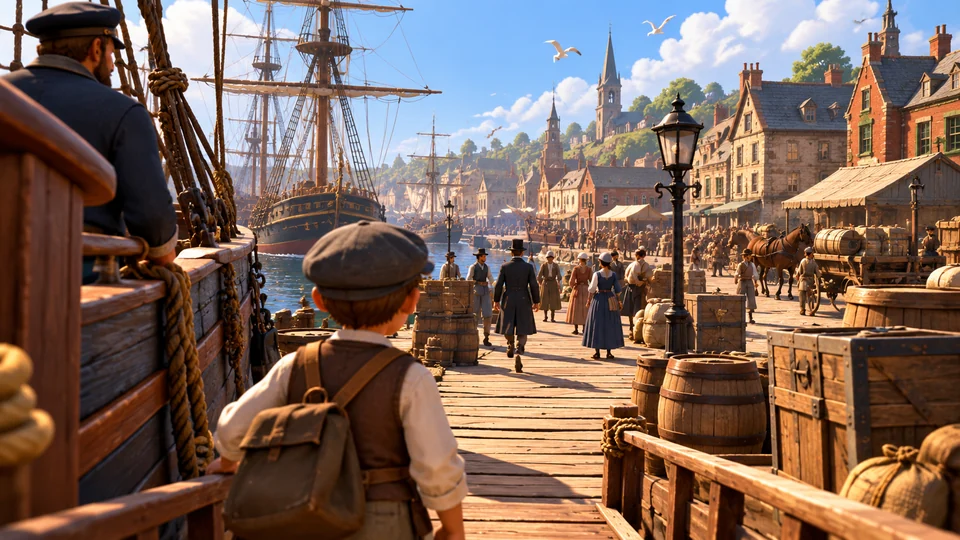 Eye height of a seven-year-old
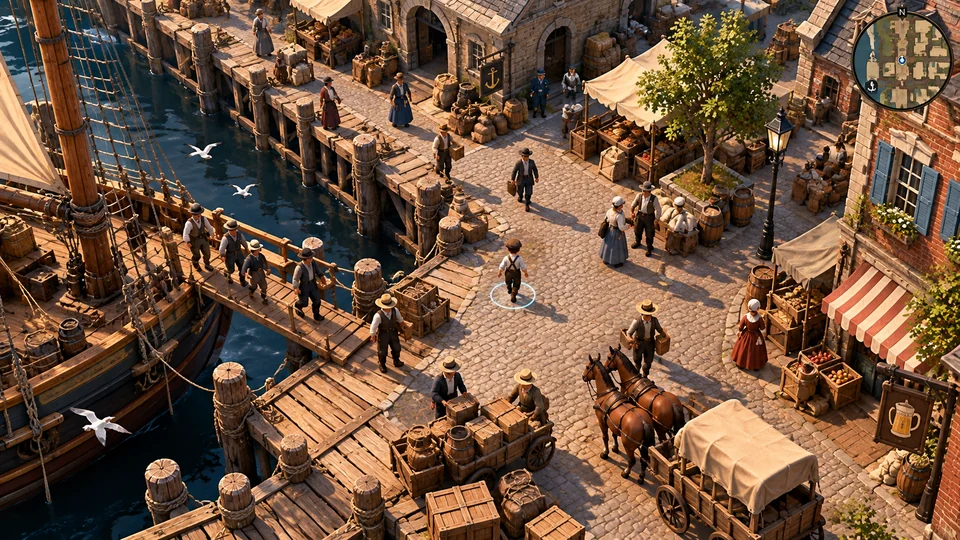 Overhead: the household, the dock, the road ahead
Time that flows like life
Look back on any meaningful moment of a life, first as diary pages and letters, then as photographs, snapshots and home movies as each technology arrives. Memories can be watched but never changed. The tree a grandmother planted is still there, and bigger, when her great-great-grandchildren play.
A day in about three hours. Weddings, births, the first morning on the trail.
A day in about an hour. The ordinary days you choose to play.
A day in about ten minutes, to get through a busy week.
Jump ahead while characters look after themselves. Skipped days are still fully lived.
People you can really talk to
Haggle with the blacksmith, comfort a friend, teach your children the family recipe. Every character answers in their own voice and their own language, from their own memories, and remembers what you told them for the rest of their life.
Margarethe Ashby, 61
Willamette Valley, Oregon · winter 1880 · speaking with her grandson Daniel, 14
Tap a German word in Learning mode to see its meaning.
The science behind the game
From psychology and family life to the weather and the stars, every science shapes something you see and feel, and every one teaches as you play.
History you can trust
Jobs, prices, technology, laws, customs and medicine match the time and place. Any historical event, object or place opens to its sources, and the game always shows how certain we are about what happened.
Built from real record types: census pages, baptism entries, land deeds, the documents family historians use.
A real, well-documented society, with the family carefully invented to fit it.
Drawn mainly from archaeology, oral tradition and sacred texts, presented as each tradition tells it.
Classroom mode turns on lesson guides, context cards at key moments, vocabulary and discussion questions. The simulation itself is unchanged, so students play the same game everyone else does.
In 1849, the year of the California gold rush, cholera spread along the crowded Platte River road. It was among the leading causes of death for emigrants, and many diaries record graves beside the trail.
Every historical detail in the game opens a panel like this one, with real sources you can look up yourself.
One world, every screen
Web browser, Windows, macOS, Linux, iPhone, iPad and Android. Life Legacies measures what each device can do and scales the detail, never the world. The sky, the weather, the story and your family are identical everywhere, so a save started on a phone replays exactly on a desktop.
Never changes, on any device
Back up and restore saves everywhere. iCloud sync on iPhone and iPad, Google's equivalent on Android, export and restore on desktop. Cross-platform sync through SeriousPass later.
Every device plays the same story; only the detail changes. This page works the same way: its living sky adjusts itself to your device.
For families, students and teachers
History is shown honestly, including war, hardship and injustice, but with care. Graphic violence and strong language are censored, nudity is always blurred, and illness, birth and death are shown with restraint. Target rating: Teen.
Realistic, Relaxed or Story settings decide how much day-to-day care the game asks of you: warmth, hunger, rest, and the needs of the babies and children in your care.
English at launch, with more player languages to come. An optional setting shows only what your character understands, so an immigrant family really does learn the language of its new home.
No. Your first life begins at about seven in the 1820s, either arriving with your family by ship or growing up on a Virginia or Tennessee farm: old enough to explore, ask questions, make friends and remember. When you carry on as your children, you can pick up their lives in childhood too.
Both. Explore in first person at your character's real eye height, or lift the camera into an overhead view to run the household, the farm and the journey. Switch any time.
Life Legacies is in development, and no release date has been announced. Follow development below to hear first.
Web browsers, Windows, macOS, Linux, iPhone, iPad and Android. Places you visit stream in, and any region can be installed for offline play.
Yes. Most American families never took the Oregon Trail. Life Legacies also follows overseas arrivals through ports like New York, Baltimore, Charleston, Savannah, New Orleans and Galveston, and the roads, railroads and rivers that carried families south and inland. Earlier journeys, such as the Great Wagon Road from Philadelphia into the Carolinas and Georgia, belong to Life Legacies: Origins.
It's a life simulation first: friendships, love, family, work and the long arc of a life. The history is the world you live in, and Classroom mode adds lesson guides for teachers who want them.
For dates since 1836, the game replays the weather scientifically reconstructed from historical observations for that place and day. The 1820s and early 1830s use NOAA's experimental reconstruction back to 1806, checked against the weather records Army surgeons kept at US forts from about 1820. Earlier eras use climate reconstructed from tree rings and other natural records, plus weather described in historical writings.
Your save is your own family tree. In the base game your family either arrives by ship in the 1820s or is already here in Virginia or Tennessee, and you decide where it goes: the ports and cities of the East, the backcountry South, Missouri and the trails west. Expansions carry the family to today, A New Nation and Origins reach back to earlier roots, and Homelands packs open the regions families came from.
Yes. The nations along the trail are portrayed from published historical research as people with their own lives. Native-language text is limited to sourced vocabulary, and where a community does not want its language used, the game respects that.
Life Legacies is in development at SeriousPlay Games. Write to us to hear about playtests, development diaries and the day the wagons roll.
Coming to Web · Windows · macOS · Linux · iPhone · iPad · Android